
Make it a product.

My sister moved to Boston this month, and I’m planning a trip to see her in September.
I wanted to take advantage of being there and set up a few meetings to catch up with founders and LPs in the area.
So I asked Claude to pull from our databases everyone we’ve spoken to who lives in Boston. Note that whenever anyone hits our internal tables, we have a system that automatically enriches their profiles with location data.
Within about 5 minutes, I had a full list of contacts with context.
I did this all within the terminal, but I knew that the next time I went to San Francisco, New York, London, or anywhere else, I’d want to run the same query. And if Jeff were traveling, it’d be valuable to him too.
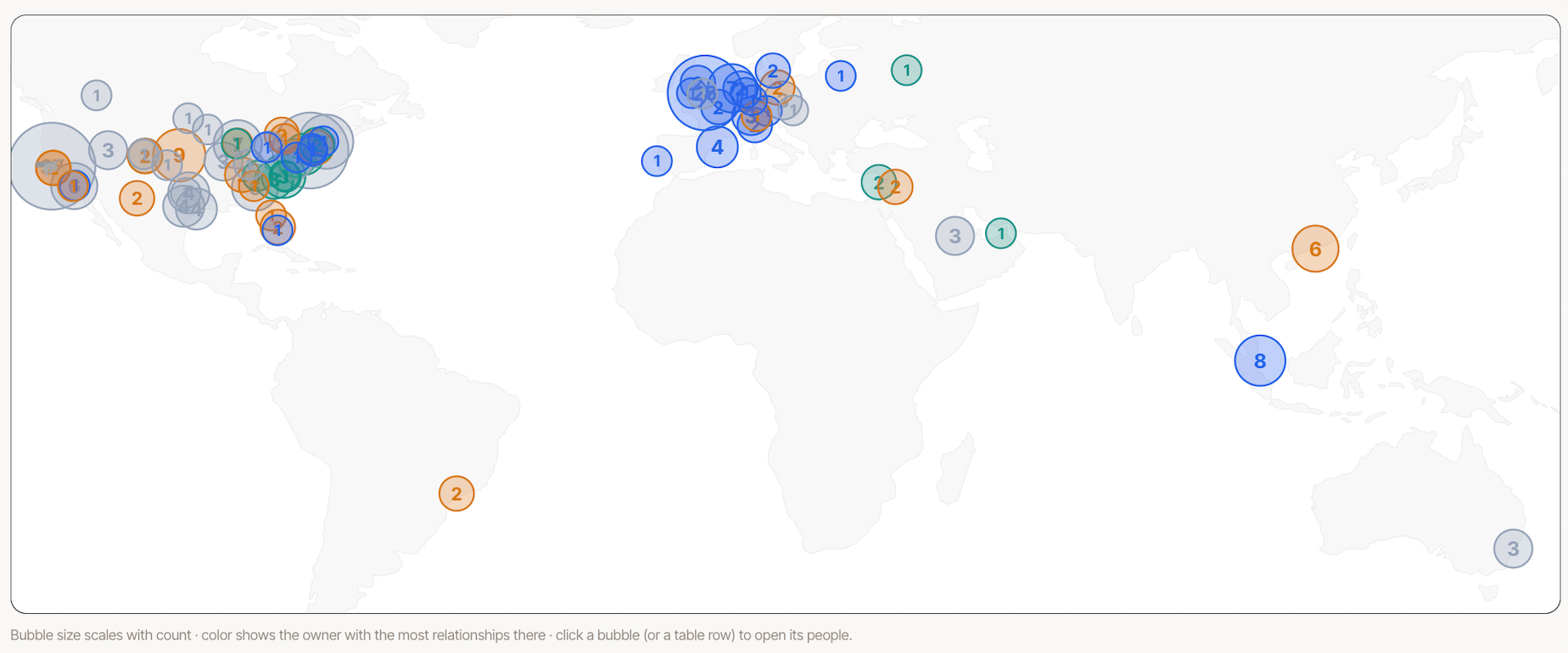
So I built a map.
It’s now a tab on our internal website where we can view our LPs geographically. The data shows where the institutions are based, where individual people live, and who on our team owns each relationship.
There is also a table under the map: you click “Boston,” and a drawer opens with the full contact list, plus links to each person’s LinkedIn, Attio profile, and previous Gmail threads.
We have a rule at the fund that if you’re ever doing something twice, you should think about turning it into a product.
For this, “product” is a loose term since it wasn’t a huge lift - just a new tab on our internal website that makes the question easier in the future. And keeps people top of mind.
I figured I’d write this quick article because I’m still getting a lot of inbound from people asking how to get onboarded to Claude and start using it in their day-to-day life.
I think there’s a mindset shift from using models to summarize and answer questions to using them to optimize and visualize how you work.
This was a super simple thing to do - took me less than an hour while doing other work - but it’s already been useful. I also didn’t know how cool it would be to see this data on a map until it was actually visualized.
Happy Friday! Hope everyone has a great weekend.
I’m a General Partner at Chapter One, an early-stage venture fund that invests $500K - $2M checks into pre-seed and seed-stage startups.
If you’re a founder building a company, please feel free to reach out on Twitter (@seidtweets) or Linkedin (https://www.linkedin.com/in/jamesin-seidel-5325b147/).